Dark Matter: The Invisible Glue of the Universe
TL;DR Summary
It makes up 85% of all matter in the universe, yet we cannot see it, touch it, or directly detect it. What is Dark Matter?
Everything you can see—stars, planets, dust clouds, your phone, yourself—makes up only about 5% of the universe. Another 27% is an invisible substance called Dark Matter, and the remaining 68% is a mysterious force called Dark Energy.
But what exactly is Dark Matter, and if we can't see it, how do we know it's there?
The Problem with Spinning Galaxies
In the 1930s, astronomer Fritz Zwicky noticed that galaxies in the Coma Cluster were moving far too fast. Based on the amount of visible matter (stars and gas) in the cluster, there wasn't enough gravity to keep the galaxies from flying apart.
In the 1970s, Vera Rubin observed a similar phenomenon in individual spiral galaxies. The stars at the outer edges of galaxies were orbiting the center at the exact same speed as stars closer to the center. According to the laws of physics, the outer stars should be moving much slower. The only explanation was that an invisible halo of mass was surrounding the galaxy, providing extra gravity.
Gravitational Lensing
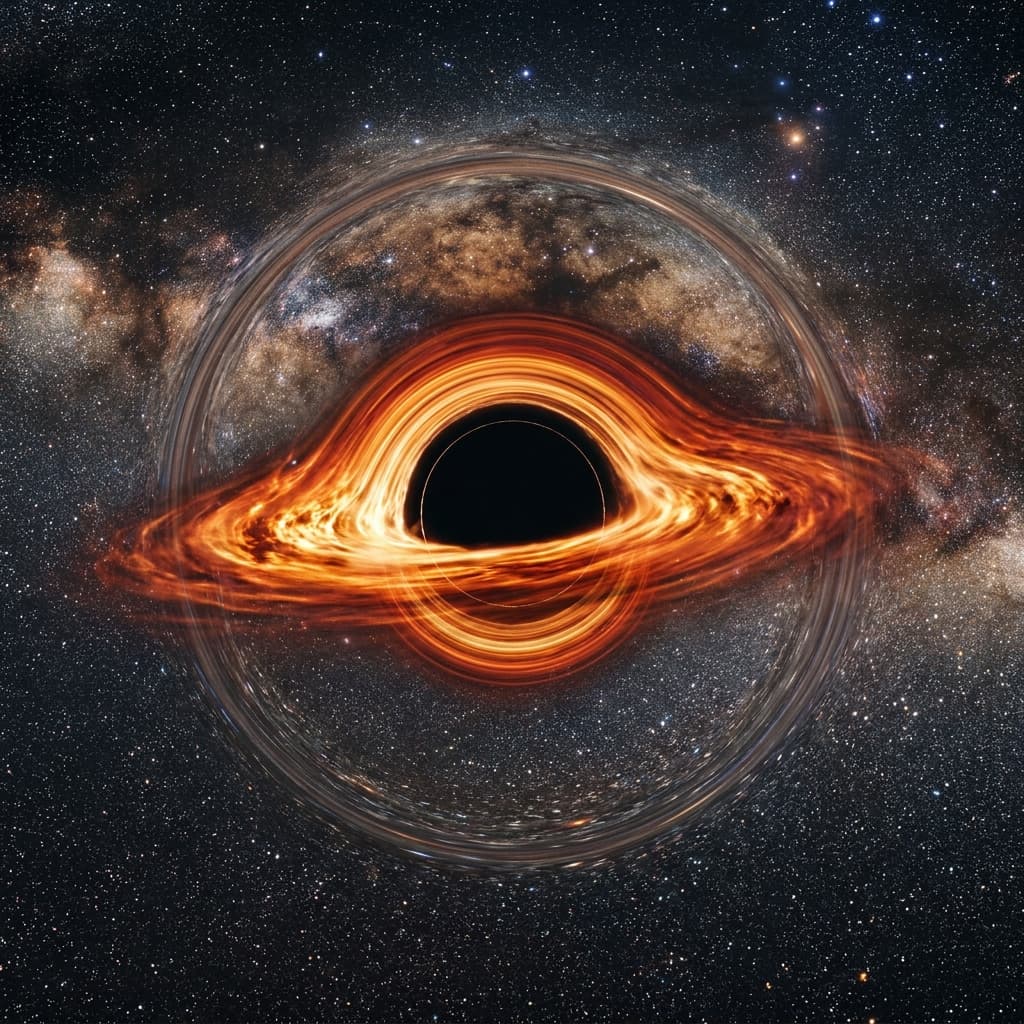
Another proof of dark matter comes from Einstein's theory of General Relativity. Massive objects bend the fabric of spacetime, causing light to curve around them. When astronomers look at massive galaxy clusters, they see the light from galaxies behind them stretched and distorted—a phenomenon called gravitational lensing.
By calculating the exact amount of bending, astronomers can measure the total mass of the cluster. In every case, the total mass is vastly greater than the visible mass.
What Could Dark Matter Be?
Scientists know what dark matter isn't. It isn't normal matter (like protons and neutrons) because it doesn't emit or absorb light. It isn't antimatter because we don't see gamma rays produced when antimatter annihilates normal matter. It isn't massive black holes because we would see them lensing light in a specific way.
The leading theory is that dark matter consists of exotic, undiscovered subatomic particles, often called WIMPs (Weakly Interacting Massive Particles). These particles have mass (and therefore gravity) but do not interact with electromagnetism (so they are completely invisible).
Billions of these particles might be passing through your body every second without you ever knowing.