Quasars: The Brightest Beacons in the Cosmos
TL;DR Summary
Quasars can shine thousands of times brighter than an entire galaxy. Discover the hyperactive supermassive black holes powering these cosmic searchlights.
When astronomers first observed the night sky with radio telescopes in the 1950s, they found strange point-like sources of intense radio waves. Because they looked like stars through optical telescopes but emitted massive radio energy, they were named Quasi-Stellar Radio Sources, or Quasars.
But quasars aren't stars at all. They are the wildly active, feeding supermassive black holes at the centers of distant, early galaxies.
How Quasars Shine
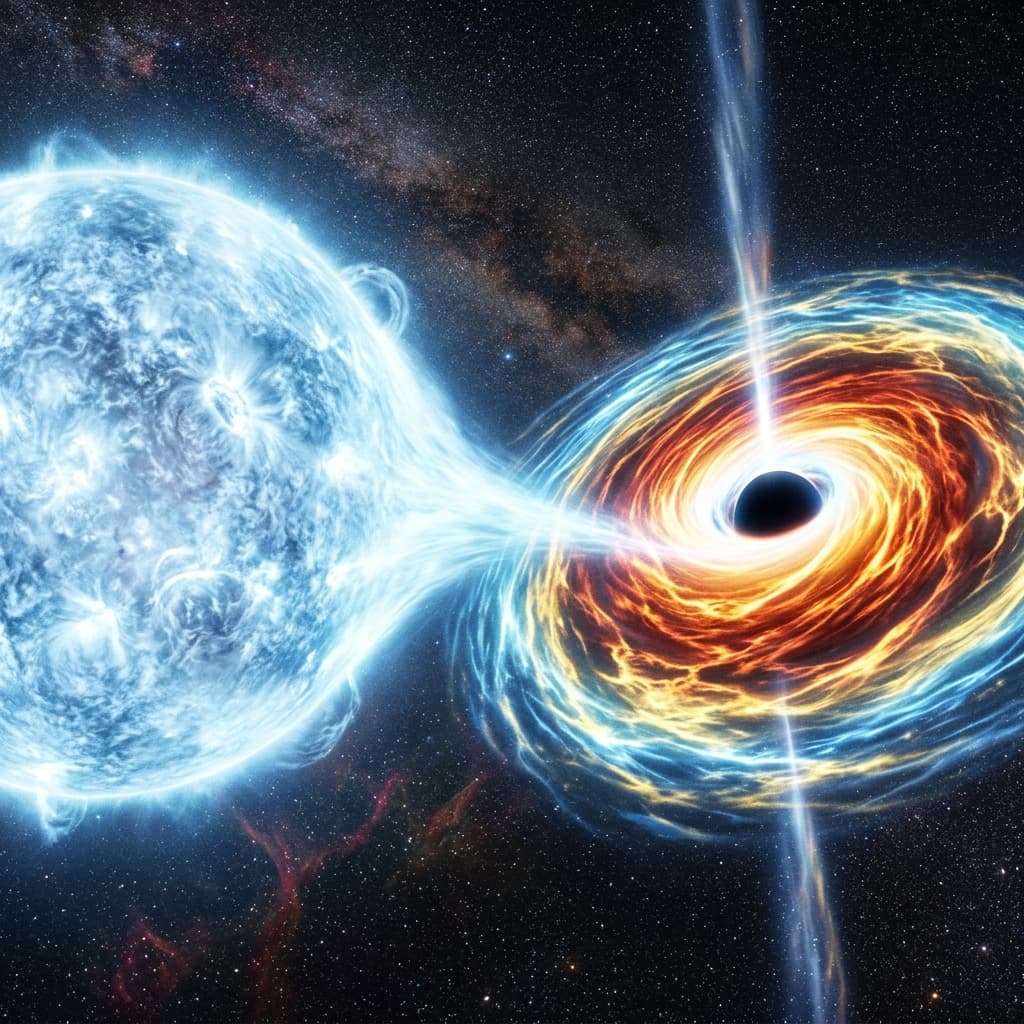
A black hole itself emits no light. However, when a supermassive black hole is actively feeding, material (gas, dust, and torn-apart stars) falls toward it, forming an "accretion disk."
The gravitational forces and immense friction cause the material in the disk to heat up to millions of degrees. The disk glows with unimaginable intensity across the entire electromagnetic spectrum, from radio waves to X-rays. Furthermore, powerful magnetic fields channel some of the infalling material into twin jets of plasma that shoot outward at nearly the speed of light.
Outshining Entire Galaxies
The energy output of a single quasar can be thousands of times greater than the entire Milky Way galaxy, which contains 100 billion stars. Yet, the energy-producing region of a quasar is incredibly compact, often no larger than our solar system.
Because they are so bright, we can see quasars that are billions of light-years away. In fact, most quasars existed in the early universe, when galaxies were young and rich in gas, providing plenty of fuel for the central black holes. As the universe aged and the gas was depleted, the quasars "turned off." The black hole at the center of the Milky Way, Sagittarius A*, is currently quiet, but it may have been a quasar billions of years ago.
TON 618: The King of Quasars
One of the most famous quasars is TON 618. Located over 10 billion light-years away, it is one of the most luminous objects in the known universe, shining with the light of 140 trillion suns. The supermassive black hole powering it is estimated to have a mass of 66 billion solar masses, making it one of the largest black holes ever discovered.